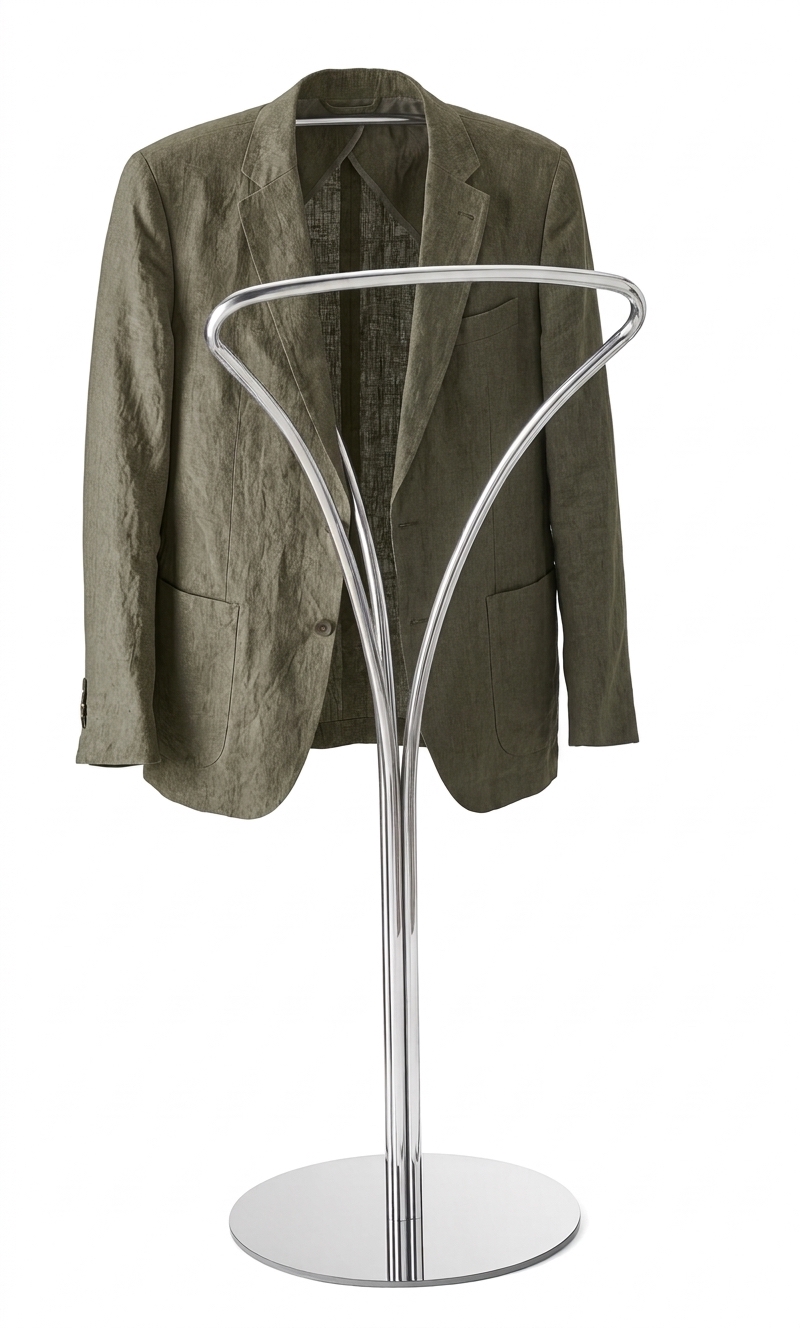
Zwei geschwungene Bügel aus Edelstahl, ein runder Fuß, sonst nichts.
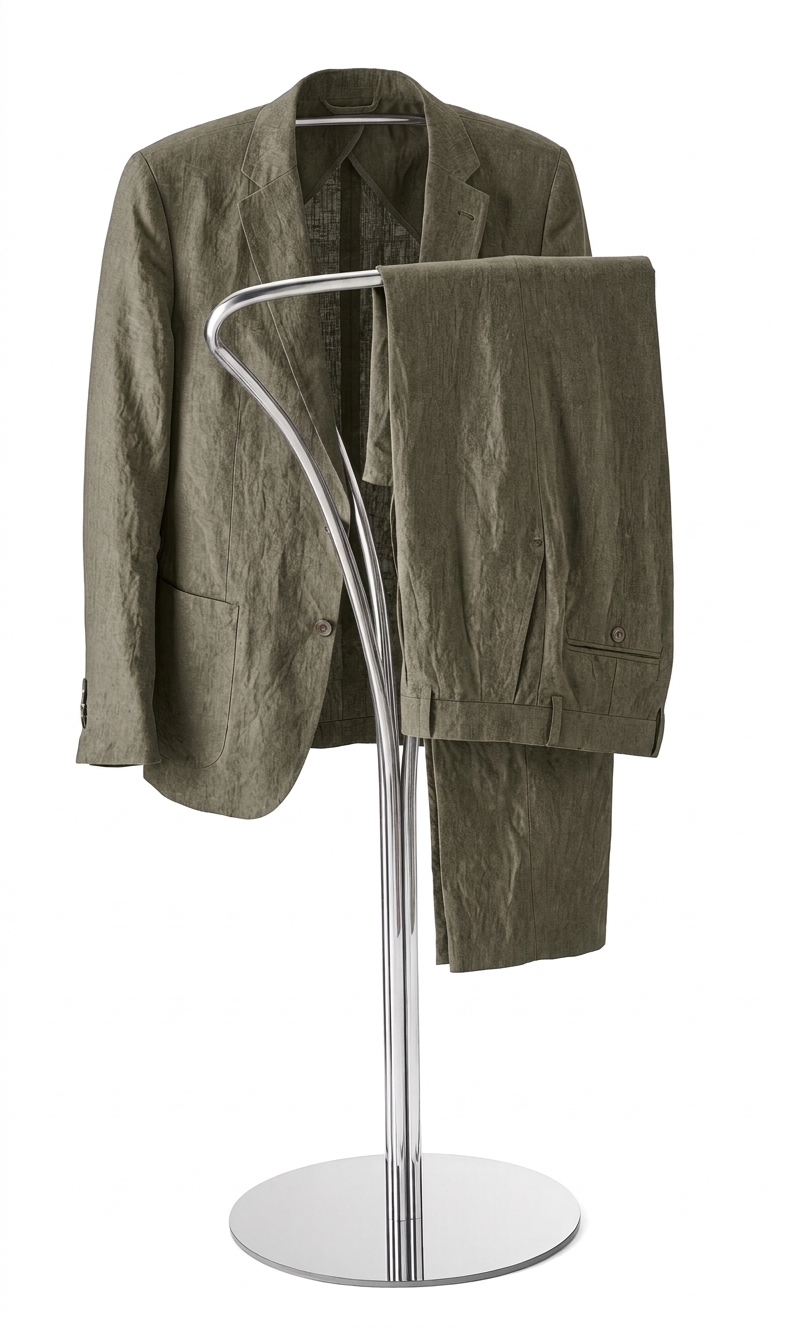
Jacke oben, Hose darunter – faltenfrei, griffbereit, ohne einen Schrank zu öffnen.
EDGAR ist als Linie gebaut, nicht als Gestell. Aus einem schlanken Schaft steigen zwei Bügel auf, der eine höher, der andere tiefer, beide zu offenen Schlaufen gebogen. Zusammen lesen sie sich wie eine Blüte oder ein Kelch: schmal unten, weit oben, ohne Ecke, ohne Kante.
Der höhere Bogen nimmt die Jacke, der tiefere die Hose. Was funktional zwei Haken wären, bleibt eine einzige Bewegung. Der runde Fuß schließt die Form und hält sie ruhig. Poliertes Metall spiegelt den Raum, statt ihn zu füllen. Deshalb wirkt EDGAR weniger wie ein Möbel und mehr wie eine Skulptur, die nebenbei den Anzug trägt.
EDGAR ist geometrisch eine geschlossene Rohrlinie auf einer Kreisscheibe, kein Gerüst aus Stäben und Winkeln. Unten liegt ein flacher Kreis als Standfläche. Sein Mittelpunkt ist die einzige Achse des Objekts. Aus ihm steigt ein schmales Bündel paralleler Rohre senkrecht auf. Bis etwa auf Hüfthöhe bleiben die Linien eng beieinander, fast wie ein einzelner Schaft. Erst darüber öffnen sie sich. Die Öffnung ist kein Verzweigen im botanischen Sinn, sondern ein Auseinanderbiegen derselben Rohre. Jedes Rohr beschreibt eine stetige Kurve ohne Knick: aus der Vertikalen in einen Bogen, dann in eine liegende Schlaufe, dann zurück in den Schaft. Es gibt zwei Schlaufen, beide annähernd oval, beide offen zur Raumseite. Die untere sitzt tiefer und weiter ausladend, die obere höher und etwas zurückgesetzt. Ihre Ebenen sind nicht parallel zum Boden, sondern leicht gekippt, sodass die Öffnungen sich im Profil überlagern. In der Aufsicht ergeben die beiden Ovale eine versetzte Doppelkontur. In der Seitenansicht wird daraus ein Kelch: schmaler Hals, weite Lippe, geschlossener Fuß. Symmetrie gibt es nur entlang der Mittelachse. Links und rechts sind die Bögen gespiegelt, oben und unten bewusst nicht. Der Höhenversatz ist die Funktion: der obere Ring trägt die Jacke, der untere die Hose. Das Material verstärkt die Geometrie. Poliertes Rohr hat keinen sichtbaren Anfang und kein Ende. Kanten, Fugen und Verschraubungen bleiben untergeordnet. Was bleibt, sind Kreis und zwei kontinuierliche Kurven.
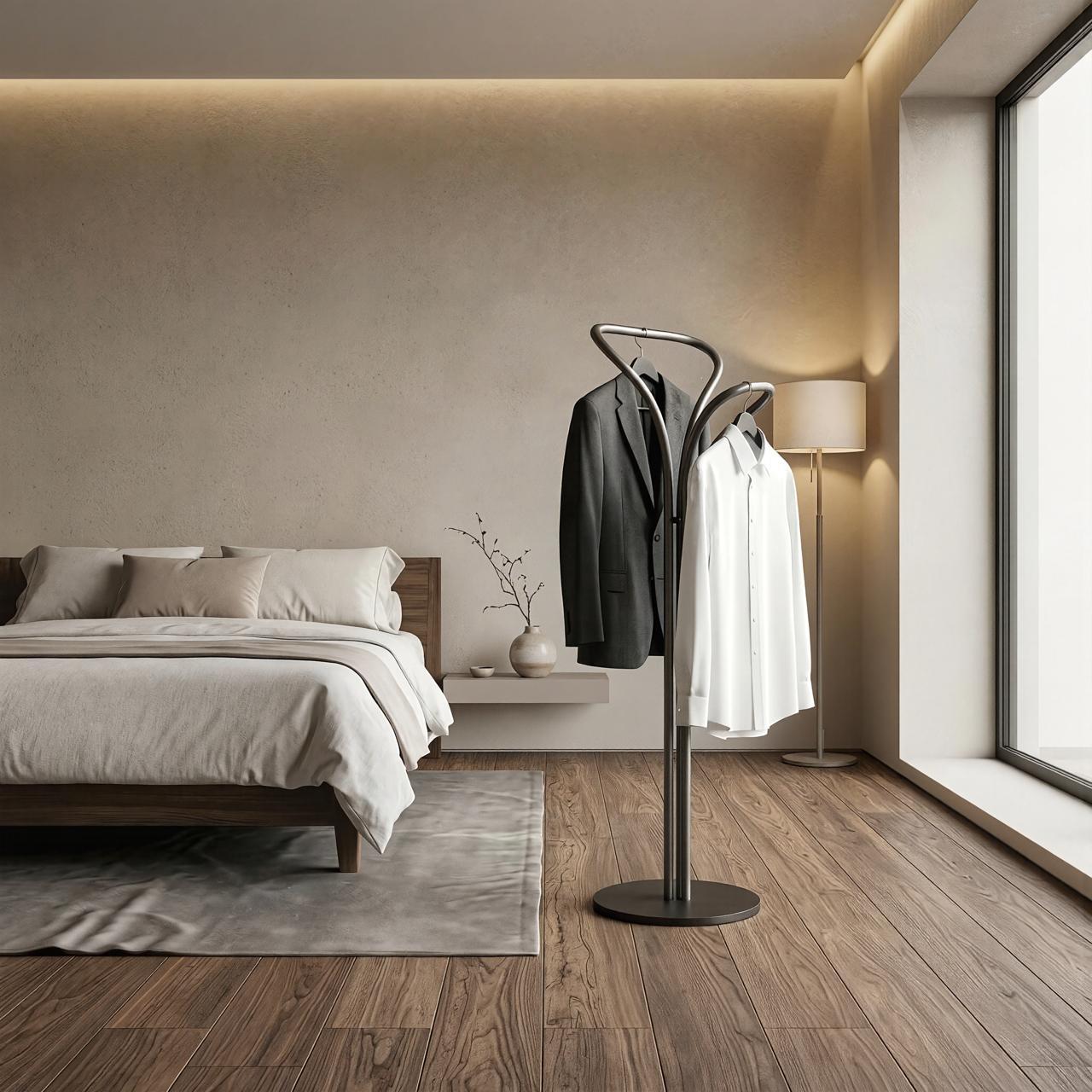
Two curved stainless steel hangers,
a round base, nothing else.
Jacket on top, trousers underneath – crease-free, within easy reach,
without having to open a wardrobe.
EDGAR is designed as a line, not as a frame. Two hooks rise from a slender shaft, one higher, the other lower, both curved into open loops. Together, they resemble a flower or a calyx: narrow at the bottom, wide at the top, with no corners or edges.
The higher hook holds the jacket, the lower one the trousers. What would functionally be two hooks remains a single movement. The round base completes the form and keeps it steady. Polished metal reflects the room rather than filling it. That is why EDGAR appears less like a piece of furniture and more like a sculpture that, incidentally, holds the suit.
Geometrically, EDGAR is a closed tubular line on a circular disc, not a framework of rods and angles.
At the bottom lies a flat circle serving as a base. Its centre is the object’s sole axis. From it, a narrow bundle of parallel tubes rises vertically. Up to about hip height, the lines remain close together, almost like a single shaft. Only above that point do they open out.
The opening is not a branching in the botanical sense, but rather the spreading apart of the same tubes. Each tube traces a continuous curve without any kinks: from the vertical into an arc, then into a horizontal loop, then back into the shaft. There are two loops, both approximately oval in shape, both open towards the room. The lower one sits lower and projects further out, whilst the upper one is higher and set back slightly. Their planes are not parallel to the floor, but slightly tilted, so that the openings overlap in profile.
In plan view, the two ovals form a staggered double contour. In side view, this becomes a calyx: a narrow neck, a wide rim, a closed base. Symmetry exists only along the central axis. The arcs are mirrored on the left and right, but deliberately not at the top and bottom. The difference in height serves a function: the upper ring supports the jacket, the lower one the trousers.
The material reinforces the geometry. Polished tubing has no visible beginning and no end. Edges, joints and screw connections remain secondary. What remains are a circle and two continuous curves.